
You’re tracking every meal. Weighing your portions. Hitting your numbers week after week. And the scale hasn’t moved in over a month.
That kind of plateau does more than frustrate — it makes you question math you were told was ironclad. Here’s what you need to hold onto before you do anything drastic: thermodynamics doesn’t make exceptions. If your body genuinely takes in less energy than it burns, it has no choice but to draw from stored fat. So when the scale refuses to move, something in that equation — intake, output, or how you’re measuring either — isn’t quite what you think it is.
One caveat before the list: weight loss is rarely linear. A flat week after a strong one is normal biology, not failure. This guide addresses a longer stall — eight or more weeks of no meaningful movement despite consistent, honest effort. Below are the seven explanations that account for the overwhelming majority of “calorie deficit, no weight loss” situations.
Jump to a reason:
- You’re overestimating your calorie burn
- You’re underestimating what you’re eating
- Metabolic adaptation has quietly lowered your burn
- Water retention is masking real fat loss
- Your “deficit” is no longer a real deficit
- Sleep, stress, or a medical condition is interfering
- Not enough time has actually passed
Reason 1: You’re Overestimating Your Calorie Burn
The most common error in the whole weight-loss process happens before you even open a food tracking app: selecting “moderately active” or “very active” when setting up your Total Daily Energy Expenditure (TDEE) calculator, when actual day-to-day movement sits much closer to sedentary. That single dropdown choice can overstate your energy needs by several hundred calories before you’ve logged a single meal.
Fitness trackers compound the problem. A widely cited Stanford Medicine study tested seven popular wrist devices — including the Apple Watch, Fitbit, and Microsoft Band — against lab-grade measurement equipment. Even the most accurate device misjudged calorie burn by an average of 27%. The worst-performing device was off by 93%. Heart rate readings were reliable across the board. Calorie estimates were not.
The practical problem: a tracker reading “550 calories burned” doesn’t mean you’ve earned 550 extra calories at dinner. These numbers are rough directional signals, not a balance you can spend.
Fix: Drop one activity level below whatever you feel you deserve when entering your numbers into a TDEE calculator. Treat tracker burn data as a trend, not a spending credit. If you’re unsure how to arrive at a realistic starting target, this step-by-step guide on how to calculate your calorie deficit walks through each variable and helps you land on a number grounded in your actual lifestyle — not an optimistic version of it. Test the adjusted figure for two weeks. If the scale responds as expected, you’ve found your real baseline.
Reason 2: You’re Underestimating What You’re Eating
This is the quiet culprit behind the majority of unexplained plateaus. Research on self-reported food intake consistently shows that people undercount their calories — not because they’re dishonest, but because eyeballing portions is genuinely, provably unreliable. A controlled study published in the New England Journal of Medicine followed participants who reported consuming under 1,200 calories a day despite showing zero weight loss. On average, they were underreporting their actual intake by more than 1,000 calories.
The culprits are rarely dramatic overeating. They’re small, repeated misses that compound quietly over time:
- Cooking oil poured freehand instead of measured — one extra tablespoon adds approximately 120 calories, and most people pour two or three without thinking
- Tasting while cooking — sauces, batters, the spoon you “just licked” before it went in the dishwasher
- Sauces and dressings, which are easy to under-measure by half
- Weekends, when tracking discipline quietly loosens across Saturday and Sunday
Fat contains 9 calories per gram — more than double what protein or carbohydrates carry — so oil-based errors do disproportionate damage. Three free-poured tablespoons of olive oil instead of one adds 240 calories you never logged. Every day, that one small habit is enough to erase a 300-calorie deficit almost entirely.
Choosing inherently lower-calorie, higher-volume foods also makes a real difference in how manageable a deficit feels day to day. If you want to rebuild your plate around foods that deliver more fullness per calorie, this guide to low-calorie foods for weight loss is a solid starting point.
Fix: Use a digital food scale for at least two weeks, even if you’re confident in your estimates. Pay particular attention to oils, nuts, nut butters, grains, and anything poured or scooped rather than presenting as a clear single unit. This one habit change resolves more stalled plateaus than almost anything else on this list.
Reason 3: Metabolic Adaptation Has Quietly Lowered Your Burn
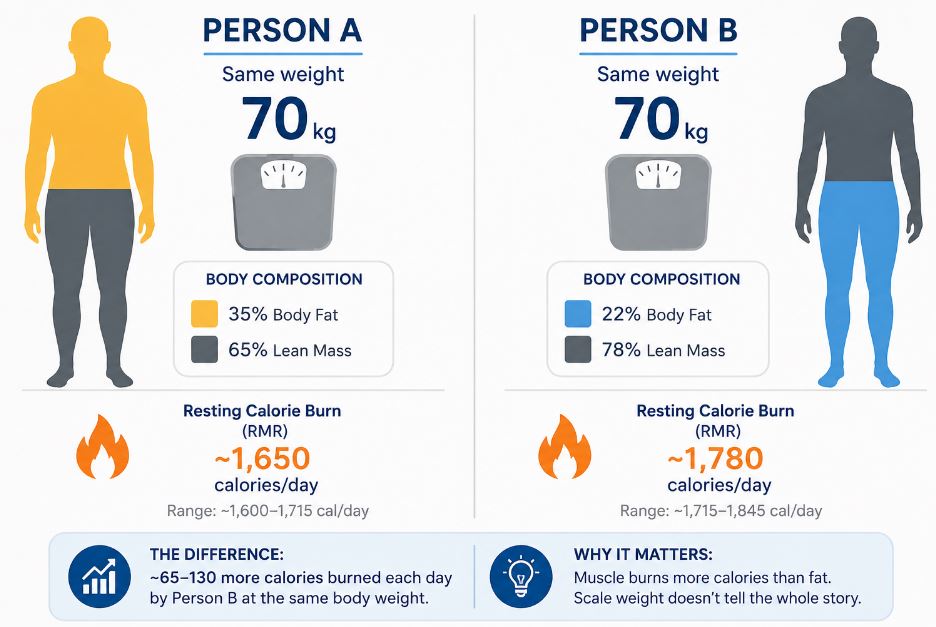
If your food is weighed, your activity level is honest, and the scale is still stuck — your body itself may have changed the equation. Prolonged calorie restriction triggers a process called adaptive thermogenesis, where the body progressively lowers its total daily energy expenditure beyond what reduced body weight alone would account for.
Part of that reduction shows up in resting metabolic rate. But the subtler and less-discussed component is NEAT — non-exercise activity thermogenesis, the energy burned through incidental movement throughout the day: fidgeting, shifting posture, pacing while you think, choosing the stairs without thinking about it. During sustained dieting, NEAT can drop meaningfully, often without any conscious awareness. You sit a little longer. You move a little less purposefully. You pick the closer parking spot. Each individual change is invisible; the cumulative effect is not.
None of this reflects a lack of willpower. It’s an established physiological response — the body’s built-in resistance to energy depletion — and it means a deficit that worked reliably in month one may genuinely no longer function as a deficit by month three. Not because you changed anything, but because your body quietly did.
Fix: Every 4–6 weeks, schedule a 1–2 week diet break at maintenance calories. This gives NEAT room to recover and allows leptin levels — which fall during sustained restriction and directly drive hunger upward — to partially normalize. Consistent resistance training throughout your deficit also matters: preserving muscle mass is the single most reliable lever you have for limiting how far your metabolic rate drops during weight loss.
Reason 4: Water Retention Is Masking Real Fat Loss
Fat loss and scale weight are not the same measurement, and conflating them is one of the fastest ways to misread genuine progress. You can lose body fat consistently for weeks while the number on the scale holds steady — or even rises — because of fluid the body is temporarily holding.
Several things trigger short-term water retention:
- High-sodium meals, because sodium draws water into bodily tissues
- New or harder training sessions, as muscle holds water during the repair and adaptation process
- Hormonal fluctuations, particularly in the week before menstruation
- Elevated cortisol from chronic or acute stress, which independently increases fluid retention
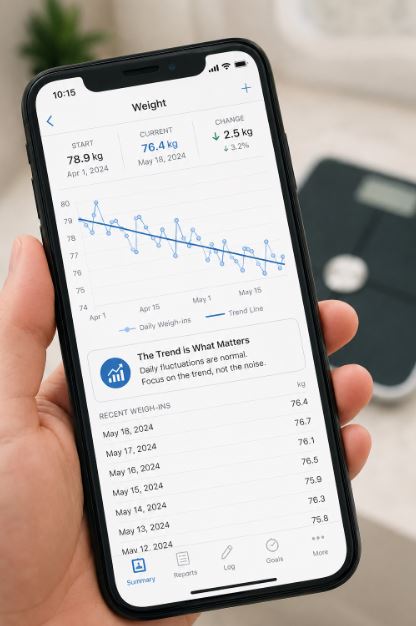
Day-to-day scale fluctuations of 1–2 kilograms are completely normal even with perfect dietary adherence. A single bad morning reading, on its own, tells you almost nothing.
Fix: Weigh yourself every morning at the same time under the same conditions — after waking, after using the bathroom, before eating or drinking. Log every reading without judgment. At the end of each week, calculate your average weight. Compare weekly averages against each other, not individual days. A consistent downward trend in those weekly averages is the only number that reliably tells you fat loss is happening.
Reason 5: Your “Deficit” Is No Longer a Real Deficit
As body weight decreases, maintenance calorie needs decrease with it — a smaller body simply burns less energy to function, to breathe, to move through the day. This is one of the most overlooked reasons a previously effective plan stops producing results, because it requires no change on your part to happen. The deficit erodes automatically as you lose weight.
Here’s a concrete illustration: someone who starts at 85 kg with a daily target of 1,800 calories may find, after dropping to 74 kg, that their maintenance level has fallen by 200–300 calories. The 500-calorie deficit they calculated at the start is now, without any adjustment to the food log, closer to a 200-calorie deficit — or near maintenance entirely.
You can re-run your numbers at your current weight using this calorie calculator. For a fuller breakdown of how to determine appropriate daily intake at your new stats — accounting for age, activity, and target rate of loss — this guide on how many calories per day covers the variables clearly.
Fix: Recalculate your TDEE every time you lose approximately 5 kg (10–11 lbs). A modest downward adjustment of 100–150 calories is typically all it takes to restart visible progress — no dramatic dietary overhaul required.
Reason 6: Sleep, Stress, or a Medical Condition Is Interfering
Sleep does more than restore energy. It regulates the hormones that govern hunger and satiety in ways most people underestimate. Research published in PLOS Medicine found that people who consistently slept around five hours a night had approximately 15% higher ghrelin (the hormone that drives hunger) and approximately 15% lower leptin (the hormone that signals fullness) compared with those sleeping eight hours. That hormonal imbalance makes adhering to a deficit measurably harder, even when the food plan stays identical.
Chronic stress compounds the problem from two directions. Sustained elevated cortisol increases fluid retention — amplifying the masking effect described in Reason 4 — and can interfere with fat mobilization at the hormonal level over time.
Two medical conditions deserve specific mention because they’re the most commonly encountered genuine metabolic interferences: hypothyroidism and polycystic ovary syndrome (PCOS). Neither makes weight loss impossible, but both can mean the deficit needs to run tighter than a standard calculator would suggest, or that the approach needs adjustments beyond calorie numbers alone.
Fix: Protect 7–9 hours of sleep consistently — not as a bonus on easy weeks, but as a non-negotiable part of the plan. Build structured recovery into your schedule. If you’ve tracked accurately, trained consistently, and prioritized sleep for eight or more weeks with no downward movement in your weekly average, that’s the threshold to see a GP and rule out a thyroid or hormonal cause before you consider tightening the deficit further on your own.
Reason 7: Not Enough Time Has Actually Passed
Sometimes there’s no hidden error, no metabolic interference, and no measurement problem. The timeline is simply too short to evaluate fairly.
Weight loss is not linear. The body doesn’t release fat at a perfectly consistent daily rate, and a flat — or even slightly upward — week following several strong ones is statistically normal, not evidence that something is broken. Sustainable fat loss for most people runs between 0.5–1 kg per week. At the lower end of that range, monthly progress is around 2 kg. That’s a change that often registers first in how clothes fit, in tape measure readings, and in side-by-side photos — well before the scale’s weekly average reflects it clearly.
It’s also worth noting that the scale is the measurement most vulnerable to the variables in Reasons 3 and 4: metabolic fluctuations and retained water can genuinely obscure weeks of real fat loss until conditions briefly align and the number drops more noticeably than expected. This is precisely the point where most people abandon an approach that was actually working.
Fix: Evaluate progress in 4-week blocks, not week-to-week snapshots. Take monthly measurements at consistent points — waist, hips, upper arms — and progress photos in consistent lighting and clothing. These frequently reveal meaningful change the scale hasn’t yet made visible.
The Bottom Line
Tracking errors, metabolic adaptation, water retention, an outdated calorie target, and lifestyle interference account for nearly every real-world case of “I’m in a deficit but not losing weight.” The temptation when progress stalls is to cut calories dramatically or overhaul everything at once. That’s rarely necessary and often counterproductive.
Work through each reason methodically. Start with the two highest-leverage fixes: weigh your food on a digital scale for two weeks, and recalculate your TDEE if you’ve lost more than 5 kg since you last set your target. Those two changes alone resolve the majority of plateaus before anything else needs to change.
If you’ve genuinely addressed all seven — consistently, for eight or more weeks — with zero downward movement in your weekly average, that’s the point to involve a doctor, not to cut calories further on your own.
Related reading:
- How to calculate your calorie deficit — a step-by-step guide
- Calorie calculator: find your personal daily target
- How many calories per day do you actually need?
- The best low-calorie foods that keep you full
A Note on Scope
This article is written for generally healthy adults using a moderate, sustainable calorie deficit. It is not a substitute for individualized medical or dietetic advice. It does not address very low-calorie diets, eating disorders, or weight loss during pregnancy, adolescence, or under medical supervision for another condition. If any of those situations apply to you, please work with a clinician — this guide is not the right tool.
Sources
- Shcherbina, A. et al. “Accuracy in Wrist-Worn, Sensor-Based Measurements of Heart Rate and Energy Expenditure in a Diverse Cohort.” Stanford School of Medicine, 2017. med.stanford.edu
- Lichtman, S.W. et al. “Discrepancy Between Self-Reported and Actual Caloric Intake and Exercise in Obese Subjects.” New England Journal of Medicine, 1992. nejm.org
- Trexler, E.T., Smith-Ryan, A.E., Norton, L.E. “Metabolic Adaptation to Weight Loss: Implications for the Athlete.” Journal of the International Society of Sports Nutrition, 2014. jissn.biomedcentral.com (⚠️ Verify URL resolves correctly before publishing — original source listed tandfonline.com, which may redirect)
- Taheri, S. et al. “Short Sleep Duration Is Associated with Reduced Leptin, Elevated Ghrelin, and Increased Body Mass Index.” PLOS Medicine, 2004. journals.plos.org
Last updated: June 28, 2026
Reviewed against peer-reviewed research from Stanford Medicine, the New England Journal of Medicine, and PLOS Medicine, and benchmarked against the current top-ranking articles on this topic for completeness and accuracy.
Pingback: How to Count Calories for Weight Loss (Beginner's Guide)