
Put 100 grams of crisps on a kitchen scale. Now put 100 grams of sliced cucumber next to them. They weigh exactly the same. One has roughly 550 calories. The other has about 15. Your stomach doesn’t count calories — it responds to volume and weight. That single observation sits at the heart of every successful, sustainable calorie deficit, and it’s the thread that runs through everything in this guide.
The urgency here is real. A 2025 European Parliament briefing found that nearly 51% of EU residents aged 16 and over are overweight, with 17% classified as obese — and no EU country is currently on track to reverse that trend. A significant part of the problem isn’t three-course dinners; it’s the daily calorie sources that slide in under the radar: the glass of wine with dinner, the milky coffee on the commute, the bread that lands on the table before every meal and the oil it gets dipped in.
This guide covers two things. It lists foods that let you eat filling portions without blowing your calorie budget. It also explains common European staples that have more calories than most people think.
Table of Contents
- The Principle: Calorie Density, Not Just Calorie Counting
- Low Calorie Foods for Main Meals
- Best Snacks for Weight Loss (With Calorie Counts)
- Drinks: The Hidden Calorie Source
- Foods to Watch on a Calorie Deficit
- Quick Answers to Common Questions
The Principle: Calorie Density, Not Just Calorie Counting
Nutrition researcher Dr. Barbara Rolls at Penn State developed the concept of “calorie density” — the number of calories per gram of food — and a 2007 study she published in the American Journal of Clinical Nutrition found that participants who reduced the energy density of their diet lost more weight and improved overall diet quality without deliberately restricting portions. The Mayo Clinic’s weight-management programme operates on exactly the same foundation.
The practical takeaway: foods high in water and fibre fill your stomach with very few calories. Foods high in fat pack a large number of calories into a small volume. That gap is where the entire strategy lives.
Two core levers make this work in practice:
- High water content — most vegetables, many fruits, and broth-based soups expand in your stomach before they are fully digested
- High fibre content — legumes, whole grains, and vegetables slow gastric emptying, meaning hunger returns more slowly after eating
A third lever worth taking seriously: protein. Clinical reviews consistently show that higher-protein diets improve appetite control and help preserve lean muscle mass during a calorie deficit. The mechanism is partly hormonal: protein stimulates satiety hormones — including GLP-1 and PYY — more effectively than carbohydrates or fat does. A lentil-and-vegetable bowl isn’t just nutritionally admirable; it keeps you fuller for longer than pasta with cream sauce at the same calorie level.
All of this only becomes truly actionable when you know your personal daily calorie target. A deficit that works well for one person may be too aggressive — or too modest — for another, depending on body composition, activity level, and goal.
🔢 Calculate My Daily Calorie Target →
Low Calorie Foods for Main Meals
Non-Starchy Vegetables (Under 35 cal per 100g)
Cucumber (15 cal), spinach (23 cal), bell pepper (31 cal), tomato (18 cal), mushrooms (22 cal), cabbage (25 cal), courgette (17 cal), broccoli (34 cal).
These are the backbone of volume eating and the most reliable tool you have for feeling genuinely full on a deficit. A 300g bowl of mixed salad vegetables costs fewer than 80 calories. The same bowl of pasta costs seven or eight times that before you’ve added any sauce. Stack your plate with these first, then build the rest of the meal around them.
Legumes — High Protein and Fibre Combined
| Legume | Calories per 100g (cooked) |
|---|---|
| Butter beans | 105 |
| Green / brown lentils | 116 |
| Kidney beans | 127 |
| Chickpeas | 164 |
Legumes are embedded in European cooking in ways that rarely get enough credit. French lentilles du Puy, Italian minestrone, Spanish cocido, Greek fasolada — these aren’t health-food trends; they’re what people around the Mediterranean have built meals around for generations. The protein-and-fibre combination delivers a sustained fullness that is genuinely difficult to match at a comparable calorie cost.
Lean Proteins
Chicken breast, cooked without skin (~165 cal/100g), is the most widely available lean protein across European supermarkets. White fish — cod, hake, pollock — runs roughly 90–105 cal/100g and is often less expensive. Egg whites (52 cal/100g) maximise protein with almost no calorie cost, though a whole egg (around 70 cal) remains one of the most satiating single foods per calorie available, largely because of its fat-and-protein combination.
Low-Fat Dairy
Skyr and 0%-fat Greek yogurt sit at 55–60 cal/100g, and both have moved into the mainstream across European supermarkets over the past decade for good reason. Quark (65–75 cal/100g), skimmed milk (35 cal/100ml), and cottage cheese (~98 cal/100g) complete a category that delivers a meaningful protein return for a modest calorie spend. These are not the chalky diet products of thirty years ago — strained Greek yogurt and skyr have a thickness that surprises people who expect something watery.
Whole Grains (Portion-Controlled)
Brown rice, cooked (111 cal/100g); wholemeal or rye bread (~75–85 cal per slice); plain porridge oats, cooked (~70 cal/100g).
Grains are not the problem. The culprit is almost never the bread itself — it’s the portion that grows without measuring, the butter applied to both halves, and the second bowl of pasta when the first was already sufficient. A slice of rye bread with cottage cheese is a reasonable, filling choice. Six slices with olive oil poured generously over them is a different calculation entirely.
Best Snacks for Weight Loss (With Calorie Counts)
In a calorie deficit, a snack has one job: stop you arriving at your next meal so hungry that every good intention goes out the window. A snack that achieves that for under 150 calories earns its place. A croissant that hits 240 calories and leaves you reaching for something else within the hour does not.
| Snack | Approx. Calories | Why It Works |
|---|---|---|
| 2 boiled eggs | 140 | High protein, consistently rated among the most satiating foods per calorie |
| 150g 0%-fat Greek yogurt | 90 | Protein and a thick texture that feels more indulgent than the calorie count suggests |
| 1 apple + 10 almonds | 160 | Fibre from the fruit, slow-burning fat from the nuts — a combination that holds |
| 30g roasted chickpeas | 120 | Protein and fibre in a crunchy format that satisfies the urge to eat something |
| Carrot and celery sticks + 2 tbsp hummus | 100–120 | Volume, protein, and something that actually requires chewing |
| 1 boiled egg + a small orange | 130 | Protein alongside fibre and vitamin C — portable and practical |
| 1 cup green tea or black coffee | 0–5 | Zero calories; mild appetite suppression as a bridge between meals |
| 2 rye crackers + cottage cheese | 100–110 | Fibre and protein together — more filling than the size suggests |
A practical note on European bakeries: the quality is exceptional, and walking past a boulangerie or pasticceria every morning is a genuine test of resolve. The issue with a croissant or pain au chocolat isn’t that it’s a bad food — it’s that at 230–250 calories with minimal protein or fibre, the return on satiety is poor. You will be hungry again long before your next meal.
Drinks: The Hidden Calorie Source
Drinks are treated, almost universally, as a free accompaniment to eating. They are not — and across Europe, this is where most calorie deficits quietly collapse, because nobody writes drinks down.
- A 175ml glass of wine: up to 158 calories, according to NHS data. A large 250ml pour — which many restaurants consider standard — adds 220 or more calories to a single dinner.
- A pint of strong lager: around 220 calories. Two or three over an evening accumulates the calorie equivalent of a full extra meal, with none of the nutritional value.
- A large latte or flavoured coffee: made with whole milk and a pump of syrup, this easily reaches 250–300 calories — comparable to a dessert, not a drink.
- A 250ml glass of fruit juice: 100–150 calories, with almost none of the fibre you would get from eating the whole fruit.
Better alternatives: water (0 cal), black coffee or espresso (~5 cal), green tea without sugar (~2 cal), sparkling water (0 cal).
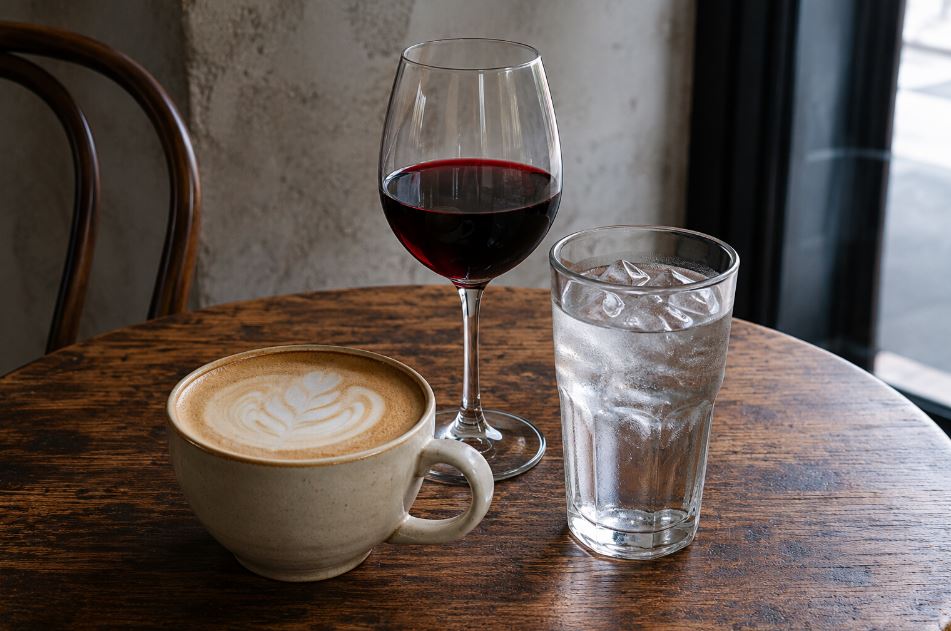
Swapping a daily large latte for a black coffee, or alternating wine with water during a night out, can remove 200–400 calories from your day without touching a single meal. Over a week, that margin is often the difference between a deficit and maintenance.
Foods to Watch on a Calorie Deficit
None of these are off-limits. They are calorie-dense — which means small portions carry more energy than they appear to — and they all feature regularly, in generous quantities, across European tables.
- Olive oil and butter: one tablespoon of either runs to approximately 120 calories. The particular trap with olive oil is its health reputation — people pour it freely over salads and vegetables, certain it’s doing them good. It is nutritious. It is also extremely calorie-dense, and the calories don’t respond to the fact that they’re arriving from a quality source.
- Cheese: a 30g portion of hard cheese — cheddar, parmesan, gouda, manchego — contains 110–130 calories. Cheeseboards and generously grated pasta toppings make it easy to reach three or four portions without registering it as a significant calorie event.
- Nuts and nut butter: among the most nutritionally dense foods available, and among the easiest to overeat. 30g of mixed nuts reaches 170–200 calories; one tablespoon of almond or peanut butter is around 90–95 calories. Worth eating — absolutely worth measuring.
- Fried food: cooking method alone adds 100–200 calories per serving compared to the grilled, baked, or boiled equivalent of the same ingredient. The potato isn’t the issue; what you cook it in is.
- Dried fruit: far more calorie-dense than fresh. 30g of raisins contains roughly 90 calories; 100g of fresh grapes contains about 70. The water has been removed; the sugar has not.
Quick Answers to Common Questions
Is bread or pasta bad for weight loss?
No — and cutting them out entirely tends to be less sustainable than learning to portion them properly. A single slice of rye or wholemeal bread is around 80 calories. A standard 80g dry portion of pasta — roughly 180g once cooked — is around 280 calories, which is a reasonable base for a meal. The issue is almost always the second helping and whatever goes on top: butter, cream sauces, and oil accumulate faster than the grain itself does.
How many snacks should I have in a day?
One or two, built around protein or fibre rather than pastry, generally fits within a moderate calorie deficit without compromising your dinner appetite. More than two starts to add up quickly, particularly if any of them come from a café or bakery counter.
Is wine really worse for weight loss than most people assume?
Yes — and the numbers are specific enough to take seriously. A glass or two most evenings adds several hundred untracked calories a week. Beyond the raw count, alcohol also tends to lower the inhibitions that otherwise govern late-night snacking decisions, so the damage often extends past the glass itself.
Do I need to go low-carb to lose weight?
No. The evidence for low-carb diets shows they can be effective — but they are not uniquely effective. A calorie deficit is the common mechanism. Reducing refined carbohydrates often reduces total daily calorie intake as a side effect, which is likely why low-carb approaches work when they do. If you function well eating bread and rice and find them satisfying, you do not need to remove them.
What about intermittent fasting?
It works for many people, not because of any metabolic advantage, but because restricting the eating window often reduces total daily calories without requiring active calorie tracking. If it suits your schedule and doesn’t trigger restriction-followed-by-overeating patterns, it is a legitimate approach. If it makes you miserable, a consistent moderate deficit is more likely to last.
How quickly should I realistically expect to lose weight?
A deficit of approximately 500 calories per day produces roughly 0.5kg of fat loss per week — a widely cited clinical estimate. Slower progress is perfectly fine. Losing faster than 1kg per week for an extended period typically means losing lean muscle alongside fat, which undermines long-term results and metabolic health.
The Bottom Line
Build your plate around non-starchy vegetables, legumes, and lean protein, with a controlled portion of whole grains. Measure your oil rather than pouring it by eye. Track your coffee and wine separately from your food — they carry more calories than most people account for, and they won’t show up anywhere unless you put them there. Choose snacks with protein or fibre over pastries that burn through in an hour.
Those habits, applied consistently, can produce a 300–500 calorie daily reduction without making any individual meal feel smaller or less satisfying. The goal isn’t to eat less food — it’s to eat more of the food that costs fewer calories per gram, and less of the food that costs more.
This article is intended for general nutrition education and is not a substitute for personalised medical advice. If you have an underlying health condition, are pregnant, or have a specific weight-loss target, a registered dietitian can tailor both your calorie target and food choices to your individual circumstances.
Sources: Mayo Clinic Healthy Weight Programme; Rolls BJ, American Journal of Clinical Nutrition (2007); European Parliament Research Service, “Obesity in the EU: An Ongoing Epidemic” (2025); NHS, “Calories in Alcohol.”
Last updated: June 2026. Fact-checked against: NHS; Mayo Clinic; European Parliament Research Service; peer-reviewed nutrition journals. This page is updated when new research is published.
Pingback: Not Losing Weight on a Calorie Deficit? 7 Common Reasons
Pingback: How to Count Calories for Weight Loss (Beginner's Guide)