
Table of Contents
- What You Need Before You Start
- How to Count Calories in Packaged Food
- How to Count Calories in Home-Cooked Food
- The Foods Most People Forget to Log
- Eating Out Without Losing the Plot
- 5 Habits That Make This Sustainable
- Conclusion
If you’ve ever typed “how do you actually count calories” into Google and then quietly deleted it because it felt like a question you should already know the answer to, you’re not alone. A striking number of people who ask this exact thing online preface it with some version of “I feel dumb for asking.” You shouldn’t feel that way. Nobody is born knowing how to read a nutrition label or weigh a bowl of daal — it’s a skill, not an instinct, and like any skill it gets easier with a few weeks of repetition.
Calorie counting works for one simple reason: it replaces guessing with measuring. And most people guess wrong, almost always downward. Studies on self-reported food intake have repeatedly found that people underestimate what they eat by a wide margin, not because they’re being dishonest, but because eyeballing portions is genuinely unreliable. This guide skips the theory and gets straight into the mechanics — what to buy, how to log packaged and home-cooked food accurately, and the five things almost everyone forgets to track.
What You Need Before You Start
Four things separate people who stick with calorie counting from people who quit in week one.
1. A daily calorie target. Without a number to aim for, logging food is just data collection with no purpose. Your target should come from your TDEE (total daily energy expenditure) — the number of calories your body burns in a typical day, including rest, digestion, and movement. If you’ve never calculated yours, this calorie calculator will give you a personalized number, your BMR, and a macro breakdown in under a minute. And if you want to understand exactly how that target is calculated — and how to adjust it once you have a few weeks of real data — this step-by-step guide to calculating your calorie deficit walks through the full formula with a worked example.
2. A food scale. This is the one tool that matters more than which app you choose. Volumetric measures lie to you: a “cup” of cooked basmati rice can weigh anywhere from 150 to 250 grams depending on how tightly it’s packed — a swing of 100+ calories from what looks like the same scoop. A cheap digital scale removes that guesswork entirely, and it’s the single upgrade most likely to make your numbers trustworthy.
3. A tracking app with a food database that matches what you actually eat. MyFitnessPal has the largest global database and the most robust barcode scanner. Cronometer is stronger on micronutrient detail if you care about more than calories. Healthify (formerly HealthifyMe) has built its entire product around South Asian cuisine, and its database of regional dishes — daal preparations, roti, biryani, home-style curries — is broader than anything a Western-built app offers. All three have free tiers that are more than enough for basic calorie tracking; you don’t need a paid subscription to get started.
4. Ten minutes a day, spent the night before. Logging tomorrow’s meals tonight, rather than scrambling to remember today’s meals at 11pm, is the single habit that determines whether tracking survives past week two. It also means you walk into the next day already knowing your plan instead of making it up meal by meal.
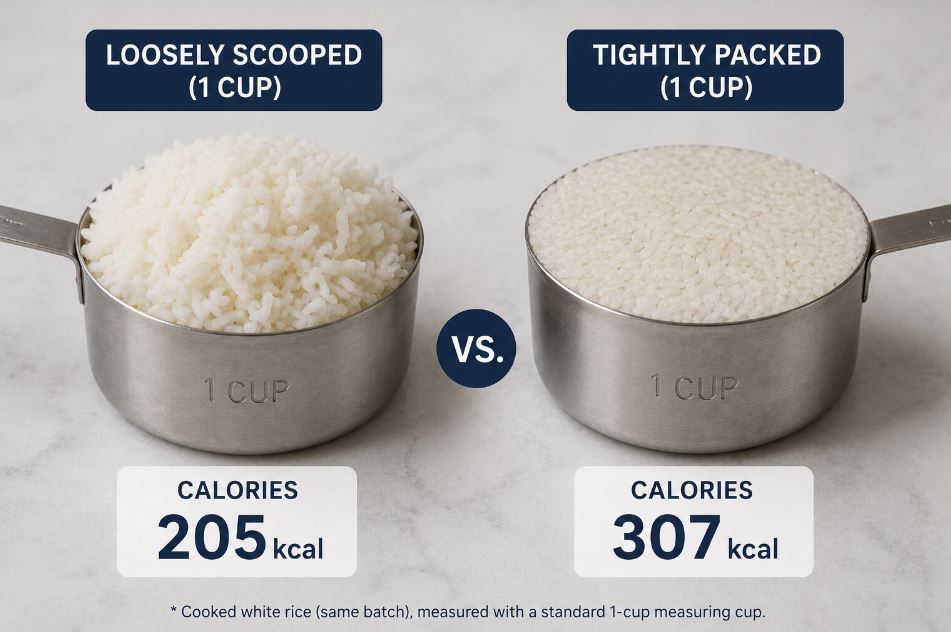
Quick win: Buy the food scale before you download the app. People who start with the scale tend to build accurate portion instincts within two to three weeks. People who start with the app alone often keep guessing at portions for months, because nothing ever corrects the guess.
How to Count Calories in Packaged Food
Packaged food looks easy because the number is right there on the label. The mistake almost everyone makes is misreading the serving size.
A label that says “200 calories per serving” with 2.5 servings per packet means the whole packet is 500 calories, not 200. Always check servings-per-container before assuming the front-of-pack number tells the whole story. The Centers for Disease Control and Prevention’s guide to reading nutrition labels is a useful five-minute primer if labels still feel confusing.
Even “1 biscuit” or “1 piece” entries vary in real weight between brands and batches, so it’s worth weighing packaged snacks when precision matters — not just home-cooked meals. Most major Pakistani and South Asian packaged products are already in MyFitnessPal’s barcode database. When one isn’t, enter it manually straight from the label rather than searching for a close substitute, since substitutes rarely match the real product closely enough to be useful.
How to Count Calories in Home-Cooked Food
This is where most beginners lose accuracy, because home cooking has no label to read.
Weigh ingredients raw, before cooking. Cooking changes water content and weight, but it doesn’t change the calorie content of the ingredient itself. A 100g portion of raw rice is roughly 360 calories whether it ends up weighing 250g or 320g after boiling — the water it absorbs adds weight, not energy.
For mixed dishes like curries, you have two practical options: log every ingredient as you add it, or build the dish once as a “recipe” inside your app (MyFitnessPal, Cronometer, and Healthify all offer some version of a recipe builder) and reuse it every time you cook it. The second option takes more effort upfront but saves real time once your most-cooked dishes are saved.
The table below gives rough starting points for common Pakistani staples, cooked and ready to eat:
| Pakistani staple (cooked) | Approx. calories per 100g |
|---|---|
| Daal (lentils) | 110–120 |
| Roti, whole wheat, medium (~30g) | 75–80 per roti |
| Chicken curry, boneless, home-cooked | 130–150 |
| Basmati rice, cooked | ~130 |
These figures are starting estimates based on general USDA FoodData Central values for similar dishes, not guarantees for your specific recipe. Oil quantity and exact cooking method shift them meaningfully — which is exactly why the next section matters so much.
Pro tip: Build a personal “favorites” library in your app for the 15–20 dishes you eat most often. This one habit cuts daily logging time by more than half once it’s set up, because you’re selecting a saved entry instead of rebuilding a recipe from scratch every time.
The Foods Most People Forget to Log
If your tracked total never seems to match your actual weight trend, this section is almost certainly why.
Cooking oil. One tablespoon of oil is roughly 120 calories. Cook with two tablespoons and you’ve added 240 calories that never make it into a recipe search. This is the single biggest tracking error among home cooks — full stop, no exceptions. Fat is also more calorie-dense than protein or carbohydrates, at roughly 9 calories per gram, so oil-based errors do more damage per spoonful than almost any other food you’ll log.
Chai and beverages. A cup of chai with milk and two spoons of sugar runs roughly 100–140 calories. Drink five cups a day and that’s 500–700 untracked calories — more than an entire extra meal, and it never shows up as “food.”
Bites and tastes while cooking. A spoonful here, a taste-test there — it adds up to 100+ calories without ever feeling like eating, because technically it isn’t a meal.
Sauces, chutneys, and fruit. Ketchup, raita made with oil, tamarind chutney, and “free” fruit (a medium mango is roughly 100–130 calories) all carry real calorie weight that people mentally file as zero, simply because it isn’t part of the main plate.
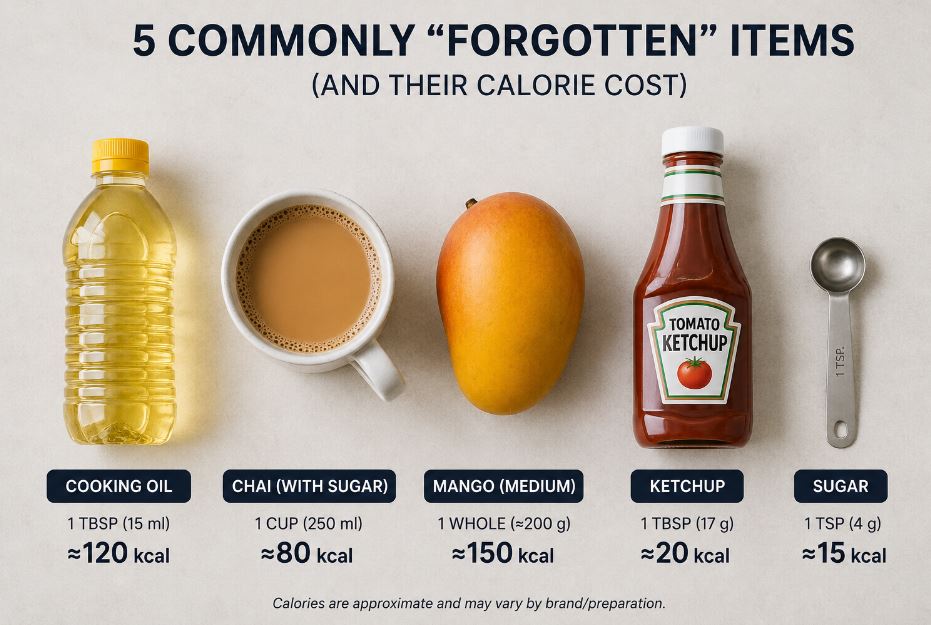
If you only fix one habit from this entire post, measure your cooking oil with a spoon for two weeks. Nothing else moves the needle faster for home cooks. And if you’re looking to rebuild your everyday meals around foods that fill you up without costing as much, this guide to low-calorie foods for weight loss is a solid next read — it covers which vegetables, proteins, and snacks give you the most volume per calorie.
Eating Out Without Losing the Plot
Restaurant meals are where precision quietly breaks down. That’s genuinely fine, because consistency matters more than precision when you’re eating out occasionally.
A few practical adjustments: choose grilled, baked, or boiled dishes over fried ones when you have the option, and ask for sauces and dressings on the side rather than mixed in. Use your app’s restaurant database entries as a starting estimate, then add roughly 15–20% to account for the extra oil commercial kitchens typically use compared to home cooking.
One untracked meal won’t undo a week of consistent logging. An entire untracked weekend, repeated often enough, will — and that’s the pattern worth watching, not any single dinner out.
5 Habits That Make This Sustainable
Pre-log meals the night before. This removes decision fatigue and prevents reactive, in-the-moment eating choices when you’re hungry and short on time.
Aim for “close,” not “perfect.” A day logged at 1,650 calories against a 1,600 target is a win. A day that doesn’t get logged at all is the actual failure.
Batch-cook proteins. Chicken breast, eggs, and lentils prepared in bulk cut your daily logging time dramatically, since you’re weighing once instead of three times a day.
Take a deliberate break every 4–6 weeks. A week of eating intuitively at maintenance gives you a mental reset and helps prevent the metabolic slowdown that can come with prolonged, uninterrupted dieting.
Review weekly, not daily. One high-calorie day doesn’t cause weight gain; a pattern across weeks does. Look at your 7-day average, not each individual number.
If you’ve been doing everything above consistently and the scale still isn’t moving, it’s worth troubleshooting before assuming the method has failed you. This guide to why you might not be losing weight on a calorie deficit walks through the most common reasons — from underestimating portions to water retention to a target that’s gone stale after weight loss — and how to fix each one.
Conclusion
Calorie counting is a skill, not a personality trait. The first week feels clumsy, and by week three it’s close to automatic. Start by logging just one meal a day for your first three days, then add a second meal, and by week two you’ll have a genuinely complete picture of your eating.
The goal was never obsession. It’s awareness — and once you actually know what you’re eating, every other decision about weight loss gets simpler.
Haven’t set your actual calorie target yet? Use the calorie calculator to get your personalized number, BMR (basal metabolic rate), and macro breakdown before you start logging — tracking only works if the target you’re tracking against is right in the first place. And if you want a deeper look at how daily calorie needs actually vary from person to person, this breakdown of how many calories you need per day is worth reading before you lock your number in.
This article is intended for general nutrition education and isn’t a substitute for personalized medical advice. If you have an underlying health condition, are pregnant, or have a specific weight-loss goal, a registered dietitian or your doctor can tailor both your calorie target and your food choices to your circumstances.
Last reviewed: July 2026. Reviewed against USDA FoodData Central and the CDC’s Nutrition Facts Label guidelines (2026).