
Last updated: July 3, 2026. Fact-checked and reviewed against peer-reviewed nutrition research, including the Longland et al. (2016) randomized controlled trial, and USDA Dietary Reference Intake / Acceptable Macronutrient Distribution Range (AMDR) guidelines.
Two people can eat exactly 1,800 calories a day and end up in very different places six weeks later. One loses body fat and holds onto muscle. The other loses weight on the scale too, but a good chunk of it is muscle — so despite the smaller number, they end up softer and weaker than when they started.
Calorie counting tells you how much you’re eating. Macro tracking tells you what that food is made of, and that difference is exactly why two people on the same deficit can get such different results.
This guide isn’t a replacement for calorie counting — think of it as a layer of precision on top of it. You’ll learn what protein, carbohydrate, and fat actually do in your body, how to calculate your own targets using a real worked example, and — just as importantly — whether you actually need this level of detail, or whether counting calories alone will get you where you’re going.
In this guide:
- What Are Macros, Really?
- Why Macros Matter Beyond Just Calories
- What Macro Ratio Is Actually Best?
- Calculate Your Personal Macro Targets
- How to Track Macros in Daily Life
- Do You Even Need Macro Tracking?
- FAQ
What Are Macros, Really?
Macronutrients — usually shortened to “macros” — are the three categories of nutrients that supply your body with energy. Every food you eat, no matter how processed or how “clean,” breaks down into some combination of these three.
Protein supplies 4 calories per gram. It builds and repairs muscle tissue, supports immune function, and — gram for gram — is the most filling of the three macros.
Carbohydrates also supply 4 calories per gram and are your body’s preferred fuel source, particularly for your brain and during moderate-to-high-intensity exercise.
Fat supplies 9 calories per gram — more than double protein or carbs — and is essential for hormone production and for absorbing the fat-soluble vitamins A, D, E, and K.
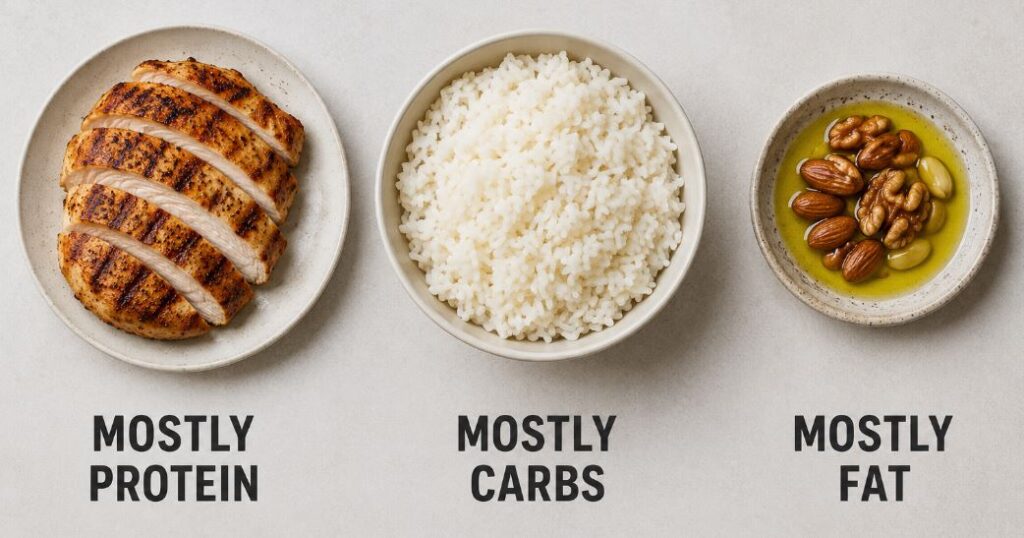
A grilled chicken breast is mostly protein with a bit of fat. A bowl of plain white rice is almost entirely carbohydrate. An egg is the outlier: it contains a meaningful amount of all three, which is part of why it shows up in nearly every macro-tracking meal plan you’ll come across.
Why Macros Matter Beyond Just Calories
Total calorie intake is what drives the number on the scale. If you haven’t nailed down how many calories you should eat per day, that’s the piece worth sorting out first — your macro targets are built on top of that number, not instead of it.
What calories don’t tell you is composition: whether the weight you lose is mostly fat, or whether a meaningful chunk of it is muscle you’d rather keep.
This isn’t just theory. A four-week randomized trial out of McMaster University, published in the American Journal of Clinical Nutrition (Longland et al., 2016), put 40 young, overweight men through six days a week of resistance training, sprint intervals, and plyometric work while running a steep calorie deficit — roughly 40% below maintenance. Half the group ate about 2.4 grams of protein per kilogram of body weight per day; the other half ate about half that, closer to 1.2 grams per kilogram. Both groups lost a similar amount of weight and improved strength by roughly the same margin across every measure tested. But body composition diverged sharply: the higher-protein group gained lean mass and lost more fat, while the lower-protein group held onto its existing muscle without gaining any, and lost somewhat less fat overall.
Worth flagging: this was a specific population — young, overweight, previously untrained men doing genuinely demanding structured training for one month. The exact numbers won’t transfer one-to-one to a 45-year-old doing three moderate strength sessions a week. But the underlying mechanism, that adequate protein blunts muscle loss during a deficit, shows up consistently enough across other research that it’s a safe principle to build a plan around, even if your own results won’t mirror the study’s numbers exactly.
Protein also carries the highest thermic effect of food of the three macros — your body spends roughly 20–30% of protein’s calories just digesting and processing it, compared with 5–10% for carbohydrates and under 5% for fat. That’s a real effect, but a modest one. It won’t substitute for an actual calorie deficit; it just makes the deficit slightly more forgiving.
Protein and fiber-rich carbohydrates are also both more satiating per calorie than fat is. If you’re constantly hungry at your current calorie target, the fix is usually more protein and more fiber, not simply less food. Building meals around a handful of low-calorie, high-volume foods makes that a lot easier to do without white-knuckling through the day.
What Macro Ratio Is Actually Best?
Here’s the honest answer a lot of macro content skips past: there is no single “best” ratio. A calorie deficit is what drives fat loss, regardless of how you split it between protein, carbs, and fat. What the evidence supports isn’t a magic percentage — it’s a hierarchy of priorities.
Protein comes first. Aim for roughly 1 gram per pound of body weight (about 2.2g per kg) per day. Depending on your calorie target, that typically lands somewhere between 25% and 40% of total calories. The lower your calorie target, the higher that percentage climbs, since a gram-based target doesn’t shrink along with your calories the way a percentage-based one does.
Fat needs a floor, not a ceiling. Keep it at a minimum of 20–25% of calories to support hormone health. It doesn’t need to dominate your plate to support weight loss, but dropping meaningfully below that floor for extended stretches isn’t a great trade-off.
Carbohydrates fill the rest, and they’re not the enemy. Whole-food carb sources — vegetables, legumes, whole grains — support satiety just as much as protein does, largely thanks to their fiber content.
For reference, the USDA’s Acceptable Macronutrient Distribution Range (AMDR) puts protein at 10–35% of calories, fat at 20–35%, and carbohydrate at 45–65% for the general population. Weight-loss-specific protein targets — including the one used in this guide — often sit at or slightly above that 35% ceiling. That’s intentional: it reflects deficit-specific research like the Longland trial above, rather than general population guidance built for people who aren’t actively trying to lose fat.
A reasonable starting split for weight loss is roughly 40% carbs / 30% protein / 30% fat, with higher-protein variants (35–40% protein) working well for people who train frequently or who struggle with hunger on a deficit.
Calculate Your Personal Macro Targets
This is the part most guides skip past with nothing but a calculator widget. Here’s the actual math, worked through with real numbers.
Step 1: Set your calorie target. Take your Total Daily Energy Expenditure (TDEE) — the number of calories your body burns in a day — and subtract 300–500 calories for a sustainable deficit. If you haven’t worked out your TDEE yet, our calorie calculator will do the math for you in a couple of minutes.
Step 2: Set protein first. Use 1 gram per pound of body weight as your primary method. Protein gets calculated before anything else, regardless of what percentage it ends up being.
Step 3: Set a fat floor. Use at least 20–25% of total calories to protect hormone function.
Step 4: Fill the remainder with carbs. Whatever calories are left after protein and fat go to carbohydrate.
Worked example — 70kg (154 lb) woman, 1,600-calorie/day target:
| Macro | Calculation | Grams | Calories |
|---|---|---|---|
| Protein | 154 lb × 1g/lb | 154g | 616 cal |
| Fat | 25% of 1,600 ÷ 9 | 44g | 400 cal |
| Carbs | (1,600 − 616 − 400) ÷ 4 | 146g | 584 cal |
That lands on a final target of 154g protein / 146g carbs / 44g fat at 1,600 calories — protein working out to about 39% of total calories here, on the higher end of the range because the overall calorie target is fairly low. Every tracking app, including MyFitnessPal under Settings → Goals, lets you enter custom gram or percentage targets instead of accepting its default split.
How to Track Macros in Daily Life
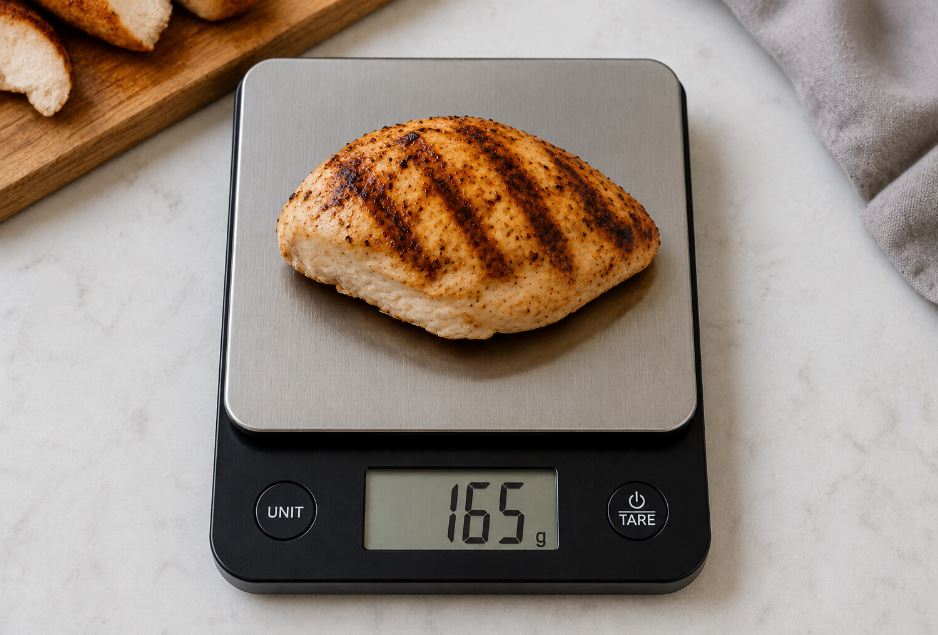
A food scale matters even more here than in basic calorie counting, especially for concentrated fat sources like cooking oil, nuts, and nut butter, where a small volume difference can swing your fat total by a surprising margin. Eyeballing “a tablespoon” of peanut butter is one of the most common ways people quietly blow their fat target without noticing.
If you can only hit one target on a given day, make it protein — it’s the macro doing the most work for body composition. Calorie total comes second. The carb-to-fat split is genuinely the most flexible part of the whole system, and it’s fine to let it drift a bit day to day as long as protein and total calories stay on track.
This flexibility is the basis of “flexible dieting,” often shortened to IIFYM (“if it fits your macros”) — the idea that any food can fit into a plan as long as it hits its calorie and macro targets. In practice, this tends to cut down on the all-or-nothing, forbidden-foods mindset that derails a lot of diets, since nothing is technically off-limits.
A few things that trip people up early on:
- Inconsistent logging of oils, sauces, and dressings — these are calorie- and fat-dense enough that “a splash” can quietly add 100+ calories.
- Forgetting that alcohol carries calories but no macros of its own, which can wreck a calorie target even when the macro split looks fine on paper.
- Chasing a perfect ratio to the exact gram every single day, which matters far less than hitting your numbers consistently across a full week.
Track consistently for 3–4 weeks, then reassess. Constant hunger usually means you should raise protein. Low energy more often means you should add some carbohydrate back in. And if the scale genuinely isn’t moving despite accurate tracking, it’s worth reading about common reasons you might not be losing weight on a calorie deficit — there are a handful of usual culprits, and most of them have nothing to do with your macro split.
Do You Even Need Macro Tracking?
No — not necessarily. A calorie deficit alone produces fat loss, and plenty of people lose weight successfully tracking only total calories. Macro tracking is a genuine upgrade, not a requirement. It’s worth adding specifically if:
- You’re constantly hungry despite being in a calorie deficit
- You’re losing weight on the scale but also losing noticeable strength
- You train consistently but aren’t seeing body composition changes that match your effort
- Your goal is body composition specifically, not just a lower number on the scale
If none of those describe you, calorie counting alone is genuinely enough. Start with how to count calories, get consistent with that first, and layer in macro tracking later once you’re ready for more precision than total calories alone can give you.
Frequently Asked Questions
Is there one “best” macro ratio for weight loss? No single ratio outperforms all others for fat loss specifically, since the calorie deficit is what actually drives the result. What changes with your macro split is muscle retention, hunger, and how sustainable the plan feels — which is why protein gets prioritized over hitting an exact percentage.
Do I need to hit my macros exactly every day? No. Consistency across a week matters far more than precision on any single day. If you can only manage one target, make it protein.
Can I lose weight without ever tracking macros? Yes. A calorie deficit alone is enough to lose weight for most people. Macro tracking is worth adding once you hit a plateau in hunger management, strength retention, or body composition — it isn’t something everyone needs from day one.
How long should I track before adjusting my targets? Give it 3–4 weeks before making changes, and expect to recalculate periodically as your body weight shifts, since a gram-per-pound protein target moves as your weight does.
Conclusion
Macros add a layer of precision on top of calorie counting — they don’t replace it. Start with your calorie target, set protein first using the worked example above, and let fat and carbs fill in around it.
Hitting your protein target inside your calorie budget is the single highest-return decision in this entire process. Everything else can be fine-tuned once that one habit is locked in.
Haven’t nailed down your calorie target yet? Read how to calculate your calorie deficit first — your macro targets only mean something once the calorie number underneath them is right.
Calculate My Calories & Macros →
This article is for general educational purposes and isn’t a substitute for personalized advice from a doctor or registered dietitian — particularly if you have an existing health condition, are pregnant or breastfeeding, or have a history of disordered eating.
Sources referenced:
- Longland, T.M., Oikawa, S.Y., Mitchell, C.J., Devries, M.C., & Phillips, S.M. (2016). Higher compared with lower dietary protein during an energy deficit combined with intense exercise promotes greater lean mass gain and fat mass loss: a randomized trial. American Journal of Clinical Nutrition, 103(3), 738–746.
- USDA Dietary Guidelines for Americans — Acceptable Macronutrient Distribution Ranges (AMDR)
- MyFitnessPal help documentation, Settings → Goals