
You can eat chicken and broccoli every day and still not lose weight. If your calorie intake isn’t below your specific maintenance level, there’s nothing for your body to respond to — clean eating doesn’t override basic energy math.
The problem is almost never motivation. It’s the absence of a real number to work toward.
What follows is a four-step method — used by registered dietitians and serious trainees alike — to calculate your calorie deficit from scratch. You’ll work through a real example at every step, get an honest take on how accurate the formula actually is, and finish with a protocol for fine-tuning the number when your first estimate needs adjusting. No app required. Just a calculator and honest answers about your daily life.
Table of Contents
- Step 1 — Calculate Your BMR (The Number That Doesn’t Move)
- Step 2 — Find Your TDEE (This Is Where Most People Go Wrong)
- Step 3 — Set Your Deficit and Lock In Your Daily Target
- Step 4 — Two Weeks of Real Data Beats Any Formula
- Free Calorie Deficit Calculators Worth Using
- The 3 Mistakes That Quietly Kill Results
Step 1 — Calculate Your BMR (The Number That Doesn’t Move)
Your Basal Metabolic Rate is the number of calories your body burns doing absolutely nothing. Heart beating, lungs inflating, cells repairing themselves overnight — zero movement, zero activity. Just the cost of being alive.
This single number accounts for 60–75% of your total daily calorie burn, which is why it’s the non-negotiable foundation of any deficit calculation. Underestimate it and you’ll eat too little. Overestimate it and you’ll wonder why nothing’s happening.
The most validated formula for healthy adults is the Mifflin-St Jeor equation, published in the American Journal of Clinical Nutrition in 1990. Multiple systematic reviews consistently show it predicts resting metabolic rate within ±10% of directly measured values for most healthy adults — a stronger accuracy rate than any competing formula:
Men: BMR = (10 × weight in kg) + (6.25 × height in cm) − (5 × age) + 5
Women: BMR = (10 × weight in kg) + (6.25 × height in cm) − (5 × age) − 161
Worked example — 30-year-old woman, 65 kg, 165 cm:
BMR = (10 × 65) + (6.25 × 165) − (5 × 30) − 161 = 650 + 1,031 − 150 − 161 = 1,370 calories/day
That’s her resting burn only. She hasn’t stood up yet. The next step is where her actual lifestyle enters the picture.
Step 2 — Find Your TDEE (This Is Where Most People Go Wrong)
Your Total Daily Energy Expenditure (TDEE) is your BMR multiplied by an activity factor that reflects how much you move across the entire day — not just during workouts.
| Activity Level | Multiplier | What It Actually Looks Like |
|---|---|---|
| Sedentary | × 1.2 | Desk job, no structured exercise |
| Lightly Active | × 1.375 | 1–3 sessions of light movement per week |
| Moderately Active | × 1.55 | 3–5 sessions of moderate gym or sport |
| Very Active | × 1.725 | Hard training 6–7 days a week |
| Extremely Active | × 1.9 | Twice-daily training or demanding physical labor |
Here’s what most calculators don’t mention: your activity level reflects your total movement, not just your gym sessions. If you work at a desk for nine hours, drive to most places, and train for 45 minutes three times a week, you’re spending roughly 3% of your weekly hours exercising and the other 97% being sedentary. Those training sessions matter — but they don’t single-handedly move you into “very active” territory.
If you’re uncertain, choose one level below what feels accurate. You can always eat more if you’re losing too fast. Overestimating your activity level by even one category inflates your TDEE by 150–250 calories — enough to wipe out an entire deficit without you realizing it.
Continuing the example: Desk job, three gym sessions per week. Three sessions sits at the boundary between Lightly Active and Moderately Active — and following the guidance above, the right call is to drop a level. That puts her in Lightly Active (× 1.375).
1,370 × 1.375 = 1,884 calories/day — that’s her maintenance.
Step 3 — Set Your Deficit and Lock In Your Daily Calorie Target
Now subtract. The size of your deficit controls both the pace of progress and the sustainability of the process. These estimates are based on the widely accepted figure of approximately 7,700 calories per kilogram of body fat — derived from the energy density of human adipose tissue, which contains roughly 80–87% lipid by weight:
- −250 cal/day → ~0.25 kg/week (ideal if you’re within 5 kg of your goal)
- −500 cal/day → ~0.5 kg/week (the standard starting point for most people)
- −750 cal/day → ~0.75 kg/week (manageable, but requires more dietary discipline)
- −1,000 cal/day → ~1 kg/week (maximum recommended without medical supervision)
For most people, −500 calories per day is the right first move. It creates real, visible results without the fatigue and hunger that come with deeper cuts — both of which are the quiet reasons most people abandon tracking in week three.
Continuing the example: 1,884 − 500 = 1,384 calories/day.
Before locking that in, one important check: is the number above the safe minimum? Per clinical guidelines published by organizations including the American Heart Association, 1,200 calories for women and 1,500 calories for men are the reference floors for structured weight loss — approximate lower limits for meeting daily protein, fiber, and micronutrient needs without supplementation. Consistently eating below these levels leads to muscle loss alongside fat, which creates a slower metabolism and harder maintenance down the line.
At 1,384 calories, her daily target sits safely above the minimum. If your calculation takes you below it, shrink the deficit until you stay above the floor. Even a 150-calorie daily deficit adds up to meaningful fat loss over weeks and months.
A common trap worth naming: chasing a number that feels strict enough to work. The deficit doesn’t need to feel aggressive — it just needs to exist, consistently, every day.
Step 4 — Two Weeks of Real Data Beats Any Formula
Here’s what most calorie deficit guides won’t say clearly: the Mifflin-St Jeor equation predicts resting metabolic rate within ±10% of measured values for most healthy adults — but at the individual level, that variance can push to ±15% or beyond, depending on genetics, thyroid function, and incidental daily movement. That’s not a flaw in the formula; it’s the nature of estimating a biological variable without a metabolic chamber test (a laboratory procedure that directly measures how many calories your body burns at rest). The formula’s estimate could be off by 150–250 calories in either direction, and you won’t know which way until you observe actual results.
The fix is treating the first two weeks as a calibration period, not a prove-it period.
The protocol:
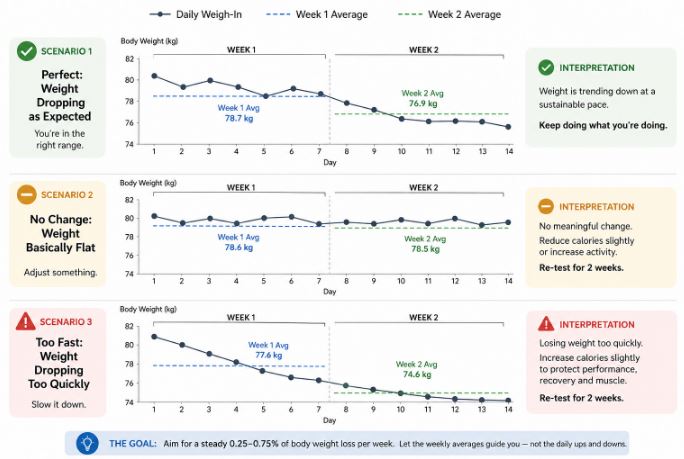
- Eat at your calculated daily target for 14 days — no untracked days in the first week
- Weigh yourself every morning at the same time, after using the bathroom, before eating or drinking
- At the end of each week, average all seven readings by summing them and dividing by seven
- Compare your week 1 average to your week 2 average
Then interpret:
- Weekly average drops by ~0.5 kg → the formula worked. Continue as-is.
- Week 2 average matches week 1 (no meaningful change) → reduce your daily target by 100–150 calories and reassess.
- Losing more than 1 kg/week unexpectedly → increase intake slightly — you may be losing muscle alongside fat.
One more step most posts skip entirely: recalculate your TDEE every time you lose 5 kg. A lighter body costs less energy to run. If you set your number at 80 kg and never update it, by the time you reach 72 kg you may be unknowingly eating at maintenance. Most prolonged weight loss plateaus aren’t a metabolic mystery — they’re a math problem with a 10-minute fix. Make this a non-negotiable habit: recalculate every 5 kg.
Free Calorie Deficit Calculators Worth Using
If you’d rather skip the manual arithmetic, three tools are consistently reliable:
- TDEE.is — clean interface, uses Mifflin-St Jeor by default, no account needed
- OmniCalculator Calorie Deficit — displays expected weekly loss alongside your daily calorie target, useful for choosing your deficit size
- MyFitnessPal (goal setup) — integrates with food logging so your target preloads every time you track a meal
Use two calculators, not one. If they agree within 100–150 calories, your estimate is solid. If they diverge by more than 200 calories, the discrepancy almost always points back to an inconsistency in the activity level you selected — go back and revisit Step 2 before adjusting anything else.
No calculator result is a fact. Every output is a starting point. Your two-week average tells you whether the starting point was right.
The 3 Mistakes That Quietly Kill Results
1. Overestimating your activity level
The most common error by a significant margin — and the hardest one to spot because it feels wrong to call yourself sedentary when you train. But the activity multiplier reflects the whole day, not the best hour of it. Three gym sessions and a desk job are lightly active, not moderately. Choosing one level too high inflates your TDEE by 150–250 calories — enough to erase your entire deficit without any obvious sign that something’s off.
2. Using your goal weight instead of your current weight
The formula must reflect the body you have right now. Your current weight is what determines your energy expenditure today. Entering your goal weight instead underestimates your TDEE and sets a calorie target that’s already too low — which usually means losing muscle faster than you should and feeling worse than necessary.
3. Not recalculating after meaningful weight loss
A 10 kg loss can reduce your TDEE by 100–200 calories. If you never update the number, the deficit that worked at the start quietly disappears. This is not your metabolism “fighting back” against you. It’s physics: a smaller body burns less energy. Recalculate every 5 kg, and plateaus become a maintenance problem rather than a motivation problem.
The Formula Gets You Close. Real Data Gets You There.
Four steps: BMR → TDEE → subtract the deficit → test and adjust. That’s the method, start to finish.
For a 30-year-old woman at 65 kg with a desk job and three weekly gym sessions, the number lands at roughly 1,384 calories per day for steady, sustainable fat loss. Your number will be different — and two full weeks of consistent tracking will confirm whether to hold it, lower it, or nudge it up.
Run the numbers. Eat to the target. Let the weekly average do the talking.
Found this useful? Bookmark it — every 5 kg of progress, come back and recalculate. The method doesn’t change. Only the numbers do.
References
- Mifflin MD, St Jeor ST, Hill LA, Scott BJ, Daugherty SA, Koh YO. “A new predictive equation for resting energy expenditure in healthy individuals.” American Journal of Clinical Nutrition. 1990 Feb;51(2):241–7.
- Frankenfield D, Roth-Yousey L, Compher C. “Comparison of predictive equations for resting metabolic rate in healthy nonobese and obese adults: a systematic review.” Journal of the American Dietetic Association. 2005 May;105(5):775–89.
- Jensen MD, et al. “2013 AHA/ACC/TOS Guideline for the Management of Overweight and Obesity in Adults.” Journal of the American College of Cardiology. 2014;63(25 Pt B):2985–3023.
Last reviewed: June 2026
Pingback: Low Calorie Foods for Weight Loss: Full 2026 Guide
Pingback: Not Losing Weight on a Calorie Deficit? 7 Common Reasons
Pingback: How to Count Calories for Weight Loss (Beginner's Guide)