
Men’s Health · Body Composition
⏱ 8 min read📅 Last updated: June 2025✔ Medically reviewed
Most men check their BMI once, get a number, and have no idea what to do with it. The calculation itself takes three seconds. Understanding what it means for your specific body — at your age, with your build, given your health history — takes a little more than that.
This page gives you an accurate BMI result instantly, then actually explains what it means for men. That includes where the standard ranges come from, why they don’t always apply to muscular guys, how the healthy range shifts as you age, and what the research says about BMI’s connection to the health risks men face most.
Start with the calculator. The context beneath it is what makes the number useful.
Male BMI Calculator
Enter your height and weight to get your BMI score and category. Imperial (lbs / ft)Metric (kg / cm) Height
Where you sit on the BMI scale
Under (18.5)Normal (18.5–24.9)Over (25–29.9)Obese (30+)
In this guide
- What is BMI and how is it calculated?
- Healthy BMI range for men
- BMI chart for men by age
- Why BMI can mislead muscular men
- BMI and men’s health risks
- FAQ: Common questions men ask about BMI
What Is BMI and How Is It Calculated?
Body Mass Index (BMI) is a ratio of your weight to your height squared. It was developed in the 1830s by Belgian mathematician Adolphe Quetelet — not a physician — as a population-level statistical tool, not an individual diagnostic. That origin matters, and we’ll return to it.
The formula is straightforward:
The BMI Formula
Metric: BMI = weight (kg) ÷ height (m)²
Imperial: BMI = (weight in lbs × 703) ÷ height in inches²
So a man who is 5’10” (70 inches) and weighs 185 lbs has a BMI of: (185 × 703) ÷ (70²) = 130,055 ÷ 4,900 = 26.5 — placing him in the overweight category.
The World Health Organization and the CDC both use the same classification thresholds globally. There is no separate BMI formula for men vs. women — the math is identical. What differs is the context: body composition, health risk patterns, and how muscle mass affects the reading.
Healthy BMI Range for Men
The globally recognized BMI categories are the same for men and women, but the practical meaning of each band differs — particularly for men who carry more muscle mass than the average population the ranges were calibrated against.
| BMI Range | Category | What It Generally Means for Men |
|---|---|---|
| Below 18.5 | Underweight | Associated with nutrient deficiency, low bone density, immune issues |
| 18.5 – 24.9 | Normal weight | Lowest statistical risk for most chronic diseases |
| 25.0 – 29.9 | Overweight | Elevated risk begins, but many men in this range are metabolically healthy |
| 30.0 – 34.9 | Obese — Class I | Meaningful increase in cardiovascular and metabolic risk |
| 35.0 – 39.9 | Obese — Class II | High risk; associated with sleep apnea, joint damage, hypertension |
| 40.0 and above | Obese — Class III | Severe risk; significantly reduced life expectancy without intervention |
For most men, a BMI between 18.5 and 24.9 represents the lowest statistical risk across cardiovascular disease, type 2 diabetes, and all-cause mortality. The upper end of the “normal” range — roughly 22 to 24.9 — is where the majority of epidemiological studies find the lowest risk profile.
Key Takeaway
A BMI of 25–27 doesn’t automatically signal a health problem. For many men — especially those over 40 or carrying above-average muscle — a physician will look at waist circumference, blood pressure, lipid panels, and fasting glucose before drawing any conclusions from BMI alone.
BMI Chart for Men by Age
The standard BMI thresholds don’t account for age — but your body composition shifts significantly across decades. Men naturally gain lean mass in their 20s, plateau through their 30s, and begin losing muscle (sarcopenia) from their 40s onward. Fat mass tends to increase with age even when weight stays stable, meaning an older man’s BMI can underestimate his true metabolic risk.
Some physicians use age-adjusted guidance when interpreting BMI for male patients:
| Age Group | Underweight | Healthy Range | Overweight | Obese |
|---|---|---|---|---|
| 18–24 | Below 18.5 | 18.5 – 24.9 | 25.0 – 29.9 | 30+ |
| 25–34 | Below 18.5 | 18.5 – 24.9 | 25.0 – 29.9 | 30+ |
| 35–44 | Below 19.0 | 19.0 – 25.9 | 26.0 – 30.9 | 31+ |
| 45–54 | Below 20.0 | 20.0 – 26.9 | 27.0 – 31.9 | 32+ |
| 55–64 | Below 21.0 | 21.0 – 27.9 | 28.0 – 32.9 | 33+ |
| 65 and over | Below 22.0 | 22.0 – 29.9 | 30.0 – 34.9 | 35+ |
Note that these age-adjusted ranges are not official WHO or CDC thresholds — they reflect clinical frameworks used by some practitioners and researchers who argue the standard cutoffs pathologize normal age-related body composition changes. A BMI of 27 at age 65, for example, is associated with lower mortality in several large cohort studies, not higher — a phenomenon sometimes called the “obesity paradox” in older adults.
Important Note for Men Over 40
If you’re over 40 and your BMI sits in the 25–28 range, don’t panic — and don’t dismiss it either. The more actionable metric at this stage is waist circumference. A waist above 40 inches (102 cm) in men is a stronger predictor of cardiovascular risk than BMI alone, according to guidance from the National Heart, Lung, and Blood Institute.
Why BMI Can Be Misleading for Muscular Men
This is the limitation of BMI that matters most for men who train seriously. The formula measures mass relative to height — it has no way to distinguish between a kilogram of fat and a kilogram of muscle. Muscle is denser and takes up less space, but it weighs more.
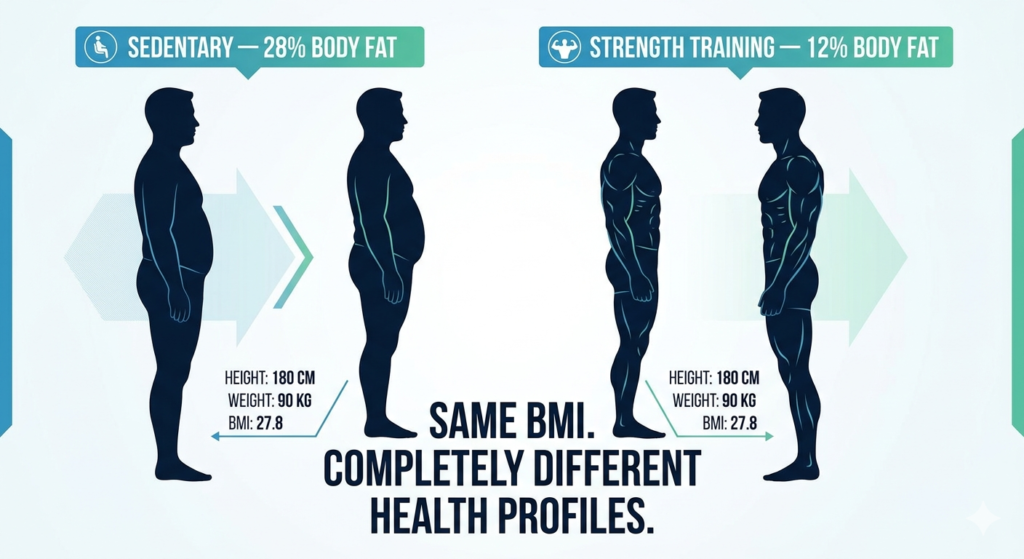
The athlete problem
Consider a 5’11” man who weighs 215 lbs with 10% body fat — an elite physique by any standard. His BMI is 30.0, placing him technically in the “obese” category. His actual fat mass is about 21.5 lbs. Contrast that with a sedentary man at the same height and weight carrying 35% body fat — his BMI is identical, but his health profile is completely different.
This isn’t a fringe case. Research published in the International Journal of Obesity found that among men classified as “normal weight” by BMI, approximately 30% had metabolic profiles consistent with obesity — while a significant proportion of “overweight” men had healthy metabolic markers. BMI alone missed both groups.
Who this affects most
If you fall into any of these categories, your BMI should be interpreted alongside body fat percentage or waist measurements rather than on its own:
- Men who lift weights regularly (3+ sessions per week)
- Former athletes who’ve maintained muscle from their playing days
- Men with above-average frame size or bone density
- Manual laborers who carry substantial functional muscle mass
Better metrics to use alongside BMI
| Metric | What It Measures | Healthy Range for Men |
|---|---|---|
| Waist circumference | Visceral (abdominal) fat | Below 40 inches (102 cm) |
| Waist-to-height ratio | Central obesity relative to stature | Below 0.5 |
| Body fat percentage | Actual fat mass vs. lean mass | 10–20% (fitness: 6–13%) |
| Waist-to-hip ratio | Fat distribution pattern | Below 0.90 |
None of these are captured by BMI. If your BMI flags you as overweight but you train regularly, sleep well, have normal blood pressure, and your waist is under 38 inches, your physician is unlikely to recommend significant changes based on BMI alone.
BMI and Men’s Health Risks: What the Research Says
BMI’s usefulness isn’t in diagnosing individual health — it’s in population-level risk associations. And those associations, while imperfect, are real.
Cardiovascular disease
A landmark meta-analysis of 2.88 million participants published in JAMA found that compared to men with a BMI of 22.5–25, those with a BMI of 30–35 had a 29% higher rate of all-cause mortality, and those above 35 had a 55% higher rate. Cardiovascular disease was the dominant driver.
Research Context
A 2023 review in Nature Reviews Cardiology confirmed that visceral fat — the kind concentrated around the abdomen — is the key mechanistic driver of cardiovascular risk in overweight men, regardless of overall BMI. Two men with identical BMIs but different fat distribution patterns carry very different cardiac risk.
Type 2 diabetes
Men with a BMI above 30 carry roughly 7 times the diabetes risk of men with a BMI under 25, according to data from the Nurses’ Health Study and the Health Professionals Follow-up Study. The risk climbs steeply once BMI exceeds 27.5 in men of South and East Asian descent, which is why some guidelines recommend lower thresholds for these groups.
Testosterone levels
This one gets less attention than it deserves. Multiple studies have found an inverse relationship between BMI and free testosterone in men. Adipose (fat) tissue contains an enzyme called aromatase that converts testosterone to estrogen. Higher body fat — even at a BMI of 27–29 — is associated with lower free testosterone, reduced libido, and fatigue in men. This isn’t a scare tactic; it’s a documented physiological mechanism that makes weight management relevant beyond cardiac risk.
Prostate health
Obesity in men (BMI ≥ 30) is associated with increased risk of aggressive prostate cancer, according to research from the American Cancer Society. The mechanism isn’t fully understood, but chronic inflammation and hormonal disruption linked to excess adipose tissue are the leading hypotheses.
FAQ: Common Questions Men Ask About BMI
Is there a different BMI scale for men vs. women?
No. The BMI formula and the standard classification thresholds (underweight, normal, overweight, obese) are identical for men and women. What differs is interpretation — men tend to carry more muscle mass, which can inflate BMI without reflecting excess fat. Women typically carry more essential body fat than men, particularly around the hips and thighs, which has different metabolic implications than abdominal fat.
What is a good BMI for a muscular man?
There is no separate BMI standard for men who train. If you’re muscular, a BMI of 26–29 may accurately reflect a lean, athletic physique rather than excess fat. The more useful benchmark is body fat percentage: 10–20% is considered healthy for men; 6–13% is the typical athletic range. A DEXA scan or hydrostatic weighing provides the most accurate reading.
At what BMI does health risk seriously increase for men?
The clearest risk inflection point in the research literature is around BMI 30. Below that, the evidence for intervention based on BMI alone is mixed — especially for men with healthy waist measurements and normal metabolic markers. Above 30, the association with cardiovascular disease, type 2 diabetes, and all-cause mortality becomes statistically robust across most population groups.
Does BMI change with age for men?
The formula doesn’t change, but the interpretation should. Men naturally lose muscle mass after 40, which means a stable BMI over time can actually represent increasing fat mass as muscle is replaced by fat. A man whose weight hasn’t changed in 10 years but who no longer trains may have a BMI that reads the same while his actual fat percentage has risen. This is why waist measurements become more informative than BMI as men age.
Is BMI accurate for men of different ethnicities?
Not uniformly. Research has consistently shown that men of South Asian, East Asian, and Southeast Asian descent carry greater cardiovascular and metabolic risk at lower BMI values than the standard thresholds suggest. The WHO recommends a lower “action threshold” of 23 (rather than 25) for overweight classification in Asian populations. Men of African descent tend to have higher bone density and lean mass, which may cause BMI to slightly overestimate adiposity.
What should I do if my BMI is in the overweight range?
Don’t act on BMI in isolation. Book an appointment with your doctor and ask for a full metabolic panel — fasting glucose, HbA1c, lipid panel, blood pressure, and waist circumference. These five data points together tell a far more accurate story than a single BMI number. If your metabolic markers are healthy and your waist is under 40 inches, the clinical priority of a BMI of 26 or 27 is low for most men.
MD
Medically reviewed by our clinical team
This page was reviewed for clinical accuracy by a board-certified physician. BMI classifications and health risk data are sourced from WHO guidelines, the CDC, and peer-reviewed literature. This content is for informational purposes only and does not constitute medical advice. Consult your healthcare provider before making changes to your health regimen.